 "Understanding the Dar es Salaam Stock Exchange Indices: Structure, Trends, and Market Implications"

M.k Butinini
03 Mar 2026


"How can investors quickly understand the performance of the Dar es Salaam Stock Exchange without analyzing each individual company?"
The answer lies in stock market indices.
A stock market index is like a thermometer for the stock market. Instead of checking the price of every company, an index tracks the overall performance of a group of selected companies. It shows whether the market, or a part of it, is going up, going down, or staying stable.
For example, the Dar Es Salaam Stock Market Exchange has several important indices
DSE All Share Index, also named as (DSEI), Tracks all listed companies, both domestic and cross-listed.
Tanzania Share Index known as TSI focuses only on domestic Tanzanian companies such as Focuses only on domestic Tanzanian companies. Examples of firms included in TSI are CRDB Bank, NMB Bank, Tanzania Breweries Limited (TBL), Twiga Cement Company, and all localized companies in the DSE Market.
Industrial & Allied Index a.k.a (IA) being used to track all industrial and manufacturing companies such as Tanzania Breweries Limited (TBL), Twiga Cement Company, Tanzania Cigarette Company (TCC), and other manufacturing firms.
Banks, Finance & Investment Index (BI) is one of the power market movers index which used by investors to tracks the overall performance of banks and financial institutions involves in the DSE MARKET including CRDB, NMB, DCB and other related financial institution.
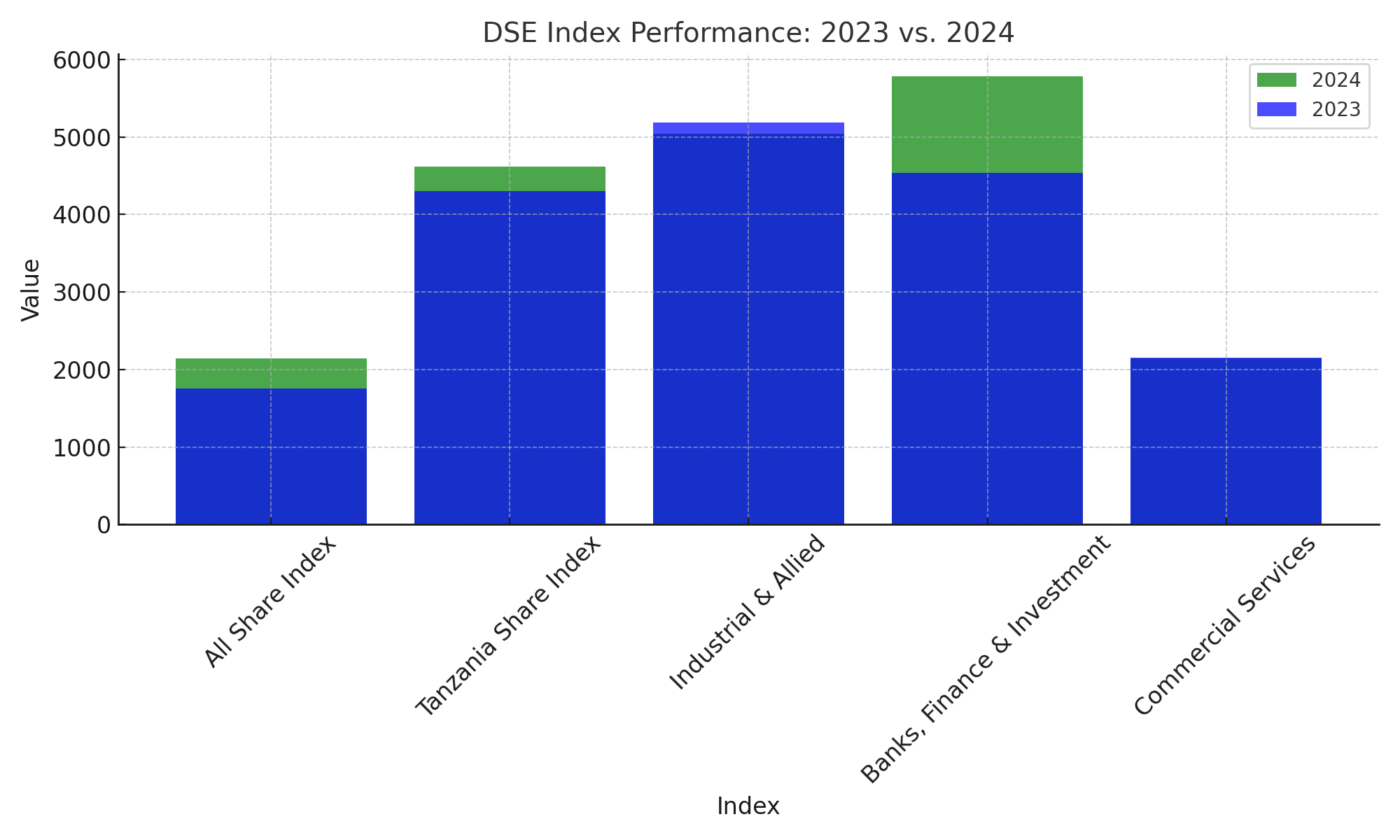
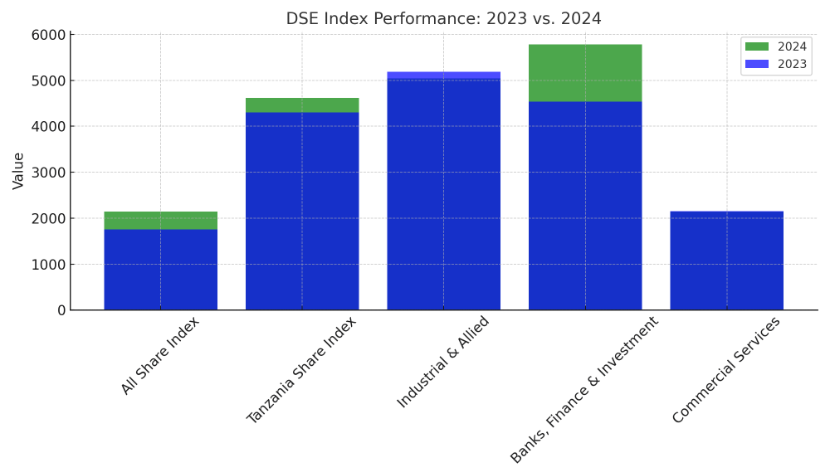
By observing and tracking indices, investors, traders, bankers and financial analyst don’t have to analyze every single company. Instead, they can rely on short and long term trends of the index like the DSE All Share Index (DSEI), the Tanzania Share Index (TSI), the Industrial & Allied Index (IA), and the Banks, Finance & Investment Index (BI) to gauge market health..
Table 2: Index Values & Weekly Change (example: end-July 2025 → early August 2025)
Index Closing Value Closing Value Weekly Change (%) All Share Index (DSEI) 2,418.85 2,466.71 + 1.98 (Tanzania Invest) Tanzania Share Index (TSI) 5,078.91 5,228.43 + 2.94 (Tanzania Invest) Industrial & Allied (IA) 4,827.76 4,776.03 – 1.07 (Tanzania Invest) Banks, Finance & Investment (BI) 8,248.40 8,763.56 + 6.25 (Tanzania Invest) Commercial Services (CS) 1,535.82 1,585.01 + 3.20 (Tanzania Invest) - Such a representative performance of the index above can be Interpreted as follows;
The BI index (financial sector) led gains showing strong investor interest in banks/finance.
TSI outperformed DSEI, indicating strong performance among domestic-only firms (excluding cross-listed).
IA declined slightly that week suggests possibly sector rotation away from industrials toward finance.
Overall rise in DSEI suggests broad market represent a positive sentiment.
In emerging markets like Tanzania Stock market indices are not only important for tracking the overall direction of the stock market but also they are essential for assessing macroeconomic sentiment in a country.
The macroeconomic perspective becomes very useful during top down approach analysis for portfolio strategy. By observing how indices like the DSEI, TSI, IA, and BI move in response to economic trends, investors can diversify their portfolio. for example,
A rising TSI index signals strong performance in domestic companies such as NMB, CRDB, Twiga Cement and other companies which , suggesting that most investors are likely to invest in local stock companies.
In the Tanzanian stock market, if the Banks, Finance & Investment Index (BI) shows gains, it may indicate a healthy and growing financial sector, signaling opportunities for investors to overweight banks and insurance stocks in their portfolios. Institutions like CRDB Bank, NMB Bank, and insurance firms often dominate this index, so their performance provides a strong signal of the sector’s overall strength.
Similarly, indices reveal which sectors are outperforming or underperforming. For example, the Industrial & Allied Index (IA), which includes companies such as Tanzania Breweries Limited (TBL), Twiga Cement, and Tanzania Cigarette Company (TCC), tends to perform well during periods of infrastructure expansion or increased industrial activity, while the BI may excel during periods of monetary tightening or strong credit growth. Portfolio managers can use these trends to rotate investments between sectors, optimizing returns based on macroeconomic conditions in Tanzania.
Indices also play a critical role in risk management and diversification. They provide a benchmark for market movements, helping investors identify concentration risk for example, the dominance of a few large banks or industrial firms in the indices and assess sector exposure.
By understanding macroeconomic trends through indices, investors can hedge their portfolios during economic slowdowns, sector-specific volatility, or unexpected policy changes, ensuring that their investments are better aligned with the Tanzanian market’s realities.
In emerging market like Tanzania with limited liquidity and concentrated sectors, understanding index movements provides a clear lens into the health and direction of the Tanzanian stock market and makes easy for anyone to invest in TANZANIA STOCK MARKET (DSE).
More articles in Tanzania financial market series
 “A Beginner-Friendly Guide to Smart Investing in the Dar Es Salaam Stock Exchange Market with Confidence"
By M.k Butinini on 23 Feb 2024
 "Mutual Funds Unleashed: The Ultimate Guide to Understanding and Investing in the Tanzania's Financial Markets"
By M.k Butinini on 18 Apr 2023


Join #TheMovement Now
Empower helps millions of job seekers and employers find the right fit every day. Start hiring now on Africa’s #1 job site.*
Become a Mover